About this work
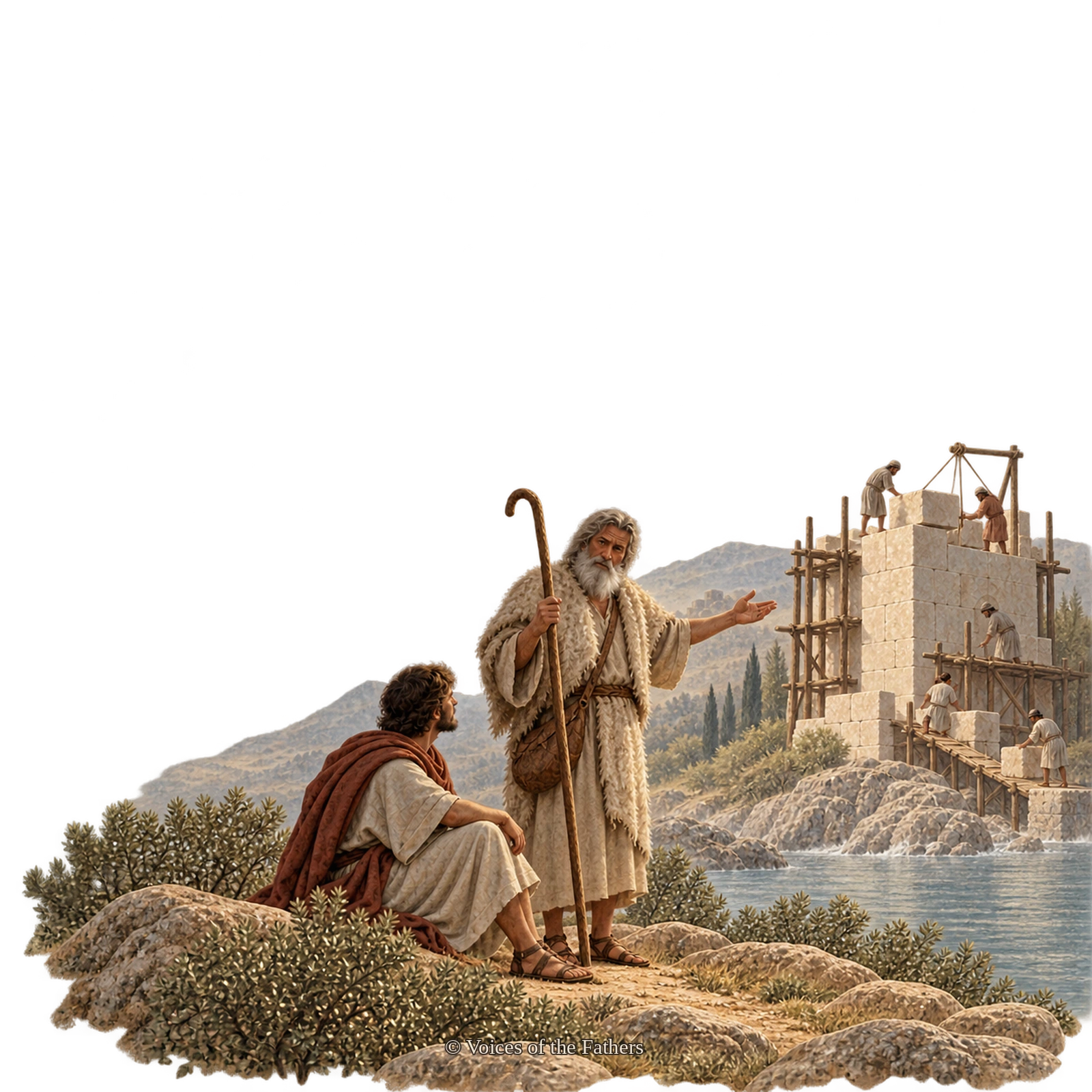
The Shepherd of Hermas is one of the longest and most influential writings of the Apostolic Fathers. Told through visions and symbolic instruction, it presents Hermas receiving a call to repentance for himself, his household, and the wider Church. Its recurring images—the Church as an aged woman and a tower under construction, the Shepherd as the angel of repentance, and the testing of stones, trees, and branches—press Christians toward faith, truthfulness, chastity, patience, generosity, and perseverance. Though not part of the New Testament canon, the work was widely read in the early Church for moral and spiritual instruction.
Historical context
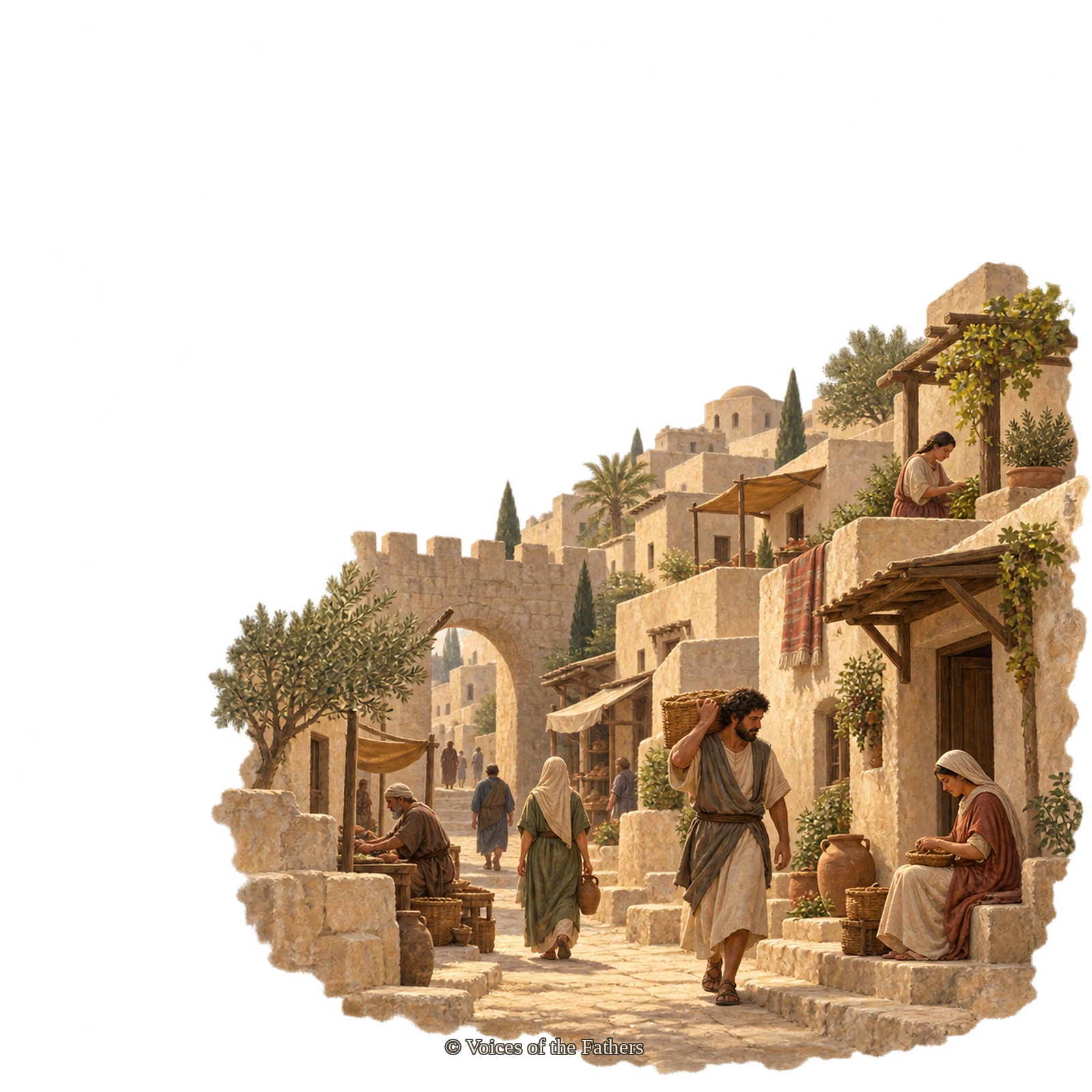
The work presents Hermas as a Christian living in Rome, a former slave who later had a household and business affairs. Its exact date and compositional history remain uncertain. The Muratorian Fragment connects Hermas with Bishop Pius of Rome and places the Shepherd in the mid-second century, while many scholars allow earlier material or a longer period of composition in the first half of the century. The work enjoyed unusually wide early circulation: it appears after the New Testament books in Codex Sinaiticus, and St Athanasius later listed the Shepherd among books appointed by the Fathers for instruction of those entering the Christian life.
Contents
The work is arranged in five Visions, twelve Mandates, and ten Similitudes. The Visions introduce Hermas’s repentance and the Church’s need for purification, especially through the image of the tower being built from living stones. The Mandates give direct moral teaching on faith, simplicity, truth, chastity, patience, discernment, prayer, and resistance to evil desires. The Similitudes expand these teachings through extended allegories about fasting, wealth and poverty, shepherds, trees, mountains, virgins, and the tower. The final movement returns repeatedly to repentance, testing, and the preparation of God’s people for judgment.
Text & source details
Editions
- Edition
- Original Text
- Reader label
- Ancient Greek and Latin — Original
- Publication
- Kirsopp Lake, The Apostolic Fathers, vol. 2 (1917); corrected digital text via Open Apostolic Fathers v1.0 (2019)
- Date
- 1917
- Rights
- Open Apostolic Fathers digital text is licensed under CC BY-SA 4.0. The ancient work itself is public domain.
- Edition
- Voices of the Fathers Modern English
- Reader label
- Modern English — VOTF
- Translator
- Voices of the Fathers editorial project
- Publication
- Voices of the Fathers
- Date
- 2026
- Rights
- Voices of the Fathers Modern English is licensed under the Creative Commons Attribution-NonCommercial 4.0 International License (CC BY-NC 4.0), to the extent copyright and related rights subsist in the translation and associated editorial material. Commercial reuse requires separate permission from Voices of the Fathers. The underlying ancient text and identified public-domain source editions retain their respective status.
- Edition
- Lightfoot–Harmer (1891)
- Reader label
- English — Lightfoot–Harmer (1891)
- Translator
- J. B. Lightfoot
- Publication
- The Apostolic Fathers, ed. J. R. Harmer (Macmillan and Co., 1891); digital text via CCEL
- Date
- 1891
- Rights
- Public domain; CCEL provider marks the digital text Public Domain.
Text and edition sources
Hermas, Pastor, CTS urn:cts:greekLit:tlg1419.tlg001.1st1K-grc1; edition represented: Kirsopp Lake, 1917.
Applies to: Ancient Greek and Latin — Original CC BY-SA 4.0The Shepherd of Hermas, Voices of the Fathers Modern English, Voices of the Fathers, 2026.
Applies to: Modern English — VOTF CC BY-NC 4.0 for the project-created translation/editorial contribution. Source websiteThe Shepherd of Hermas, Voices of the Fathers Modern English, Voices of the Fathers, 2026, CC BY-NC 4.0.
Applies to: Modern English — VOTF Source websiteJ. B. Lightfoot and J. R. Harmer, The Apostolic Fathers (London: Macmillan and Co., 1891), The Shepherd of Hermas; digital text via Christian Classics Ethereal Library.
Applies to: English — Lightfoot–Harmer (1891) Public Domain (as marked by CCEL). Source websiteOverview research
Harry Maier, “Shepherd of Hermas,” Oxford Bibliographies in Biblical Studies (Oxford University Press, 2017; reviewed 2025).
Source websiteSt Athanasius of Alexandria, Festal Letter 39 (367), section 7.
Source websiteCodex Sinaiticus Project, Shepherd of Hermas manuscript and transcription pages, fourth-century Codex Sinaiticus.
Source websiteWerner Sundermann, “Hermas, the Shepherd of,” Encyclopaedia Iranica, vol. XII, fasc. 3 (2003; updated 2013).
Source website