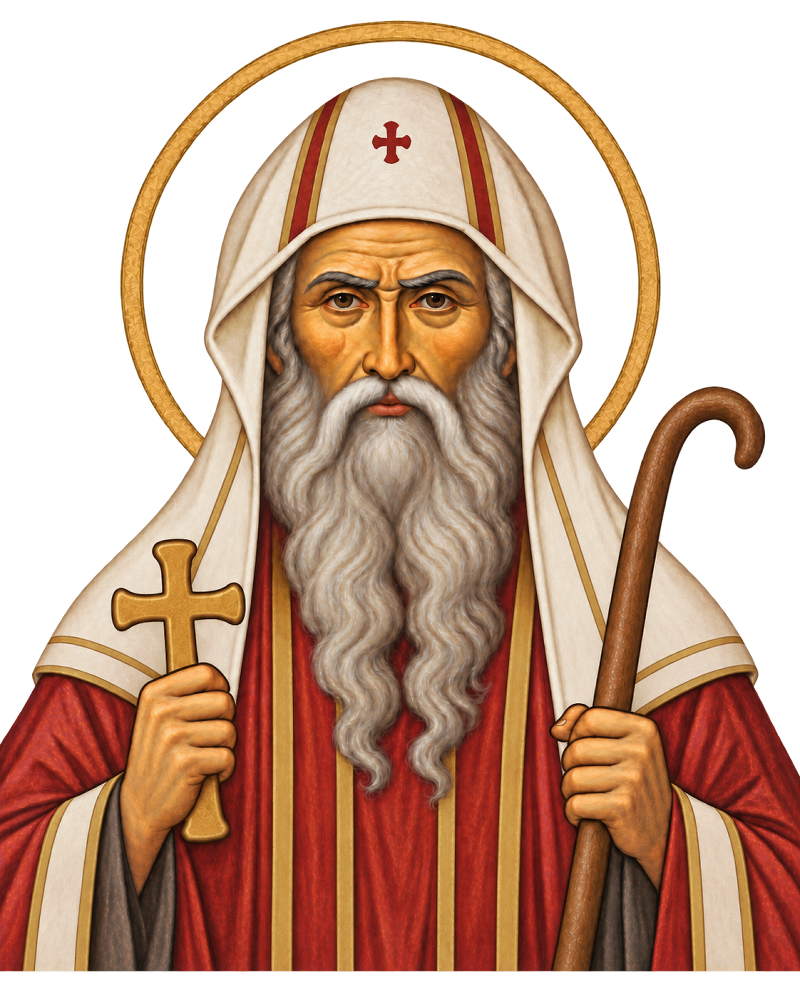
Life and significance
A commanding voice of Coptic monasticism
St Shenoute the Archimandrite (c. 347–465) was one of the most influential monastic leaders of late antique Egypt. He led a federation of three monasteries near Atripe, across the Nile from Panopolis, for roughly eight decades. Under his direction the community developed a demanding common discipline for both men and women and became an important center of Christian literary culture. Shenoute also preached beyond the monastery to clergy, laypeople, officials, and others in the surrounding region. His long leadership placed him at the center of religious and social disputes in Upper Egypt.
Shenoute’s surviving corpus, written chiefly in Sahidic Coptic, is one of the great bodies of early Coptic literature. His works include monastic rules, letters, sermons, and public discourses marked by close use of Scripture and an uncompromising moral voice. He defended the Church’s faith, opposed pagan worship, corrected his own monastic communities, and repeatedly denounced the oppression of the poor. The Coptic Orthodox Church venerates him as St Shenouda the Archimandrite and commemorates his departure on 7 Abib.